
WILLAMETTE VALLEY VINEYARDS (WVVI): SOUR GRAPES, STRESSED DISTRIBUTOR
Brought to you by Drew Millegan & The Woodworth Contrarian Fund

A shuttered WVVI tasting room in McMinnville, OR (November 2025)
WVVI: When the Distribution Bet Starts Looking Like a Credit Risk
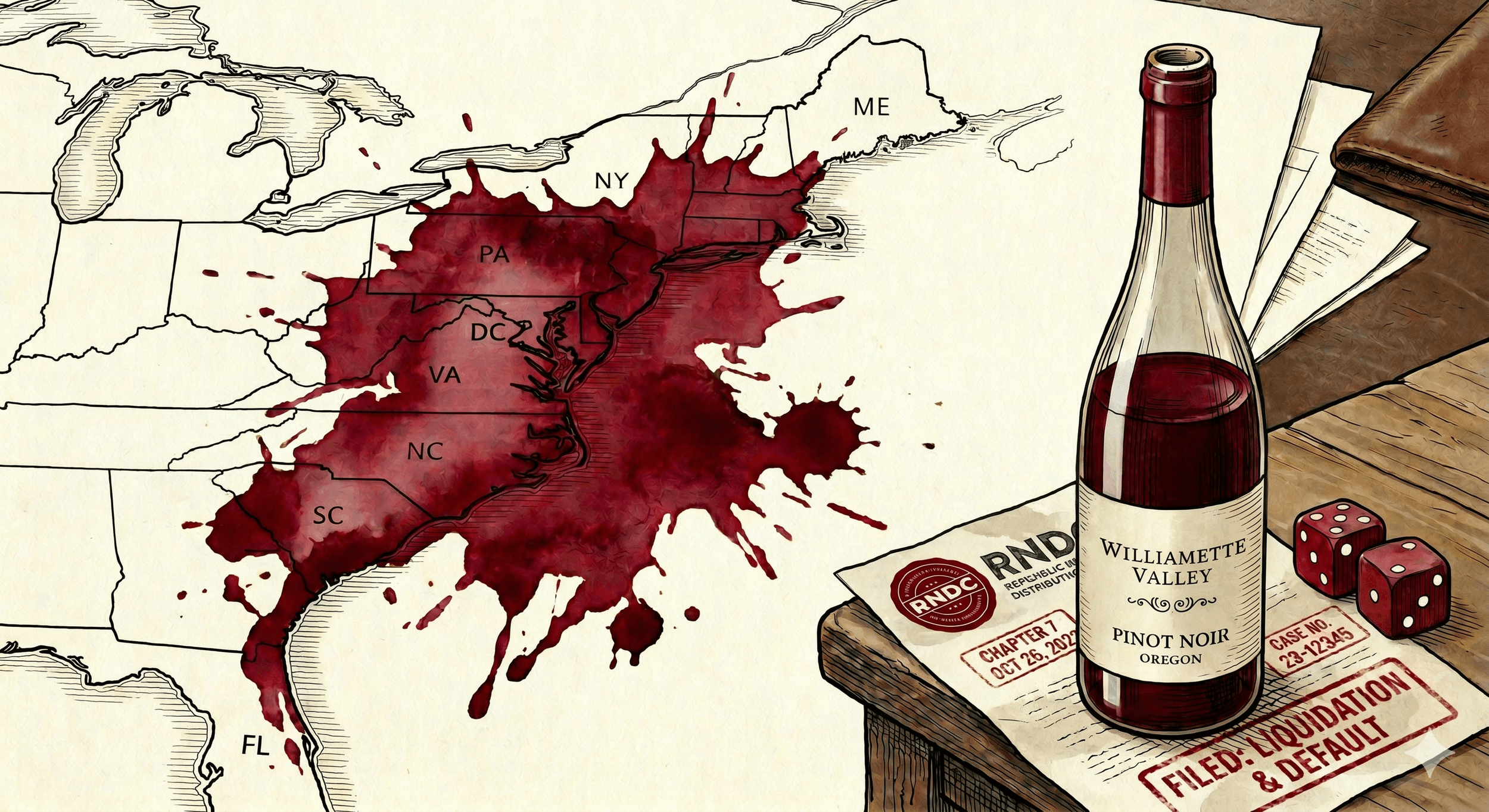
Willamette Valley Vineyards’ latest East Coast distribution reshuffle was presented as a growth initiative, but distributor RNDC’s ongoing collapse makes WVVI look materially riskier than management’s recent press releases suggest. The company aligned distribution in New York and parts of the Mid-Atlantic with Republic National Distributing Company in February 2026 even though RNDC had already shown signs of stress in key markets, making the decision look less like opportunistic expansion and more like a gamble with counterparty risk.
This is an update from our previous coverage of WVVI here: https://www.woodworth.fund/news/willamette-valley-vineyards-wvvi-not-so-great-value
The RNDC Problem
In its February 10, 2026 press release, WVVI said it was aligning distribution in New York State and the Mid-Atlantic with RNDC and framed the move as a way to expand brand representation and deepen East Coast reach. That language may read well in a release, but it also raises an uncomfortable question: why would WVVI lean harder into RNDC at a time when distributor instability was already becoming visible enough that any prudent supplier should have been scrutinizing collection risk more closely?
This matters because distributor transitions are never just about sales coverage. They also change who controls sell-through, inventory movement, retailer relationships, and, most importantly, who owes the winery cash after product is shipped. If RNDC was already pulling back in California, that should have been a warning that the company’s footprint was not simply being optimized but potentially being retrenched in response to deeper operational or financial pressures.
Why Q1 Growth Looks Lower Quality
WVVI’s first-quarter 2026 filing showed net sales rose to $8.26 million from $7.54 million a year earlier, and distributor sales increased to $4.03 million from $3.23 million. That means a meaningful share of the quarter’s growth came from the distributor channel rather than the direct-to-consumer business, which is exactly the area where payment risk becomes more dangerous if a wholesale partner is stressed.
The same filing showed direct sales declined year over year to $4.23 million from $4.31 million, while distributor sales represented 48.8% of total sales versus 42.8% in the prior-year period. In other words, WVVI’s reported growth leaned more heavily on third-party distribution at the same time it was reshaping relationships in the channel, making the quality of that growth look less secure than the headline revenue figure implies.

The Receivables Risk
For a supplier, the danger in switching distributors into a stressed counterpart is simple: the wine can be delivered, the sale can be booked, and the cash can still fail to arrive on time or in full. WVVI reported accounts receivable of $3.86 million as of March 31, 2026, which is large enough that any disruption in distributor collections could become more than a nuisance for a company already operating with thin liquidity. This is as compared to receivables of $2.32 million as of prior year March 31, 2025.
That risk is especially important because WVVI’s own balance sheet does not leave much room for a surprise. As of March 31, 2026, the company reported only $404,712 of cash, a $243,699 bank overdraft, and $2.36 million outstanding on its Columbia Bank line of credit. A delayed payment cycle from a major distributor would not just hurt optics; it could intensify dependence on lenders almost immediately.
Despite producing much less (as has much of the industry due to broad-market weakness), actual wine inventories year over year have barely budged. This means that WVVI is likely having difficulty moving product compared to prior year, and adds a further pain point in the case that they are stiffed by their distributor.
Credit Covenants Are the Other Pressure Point
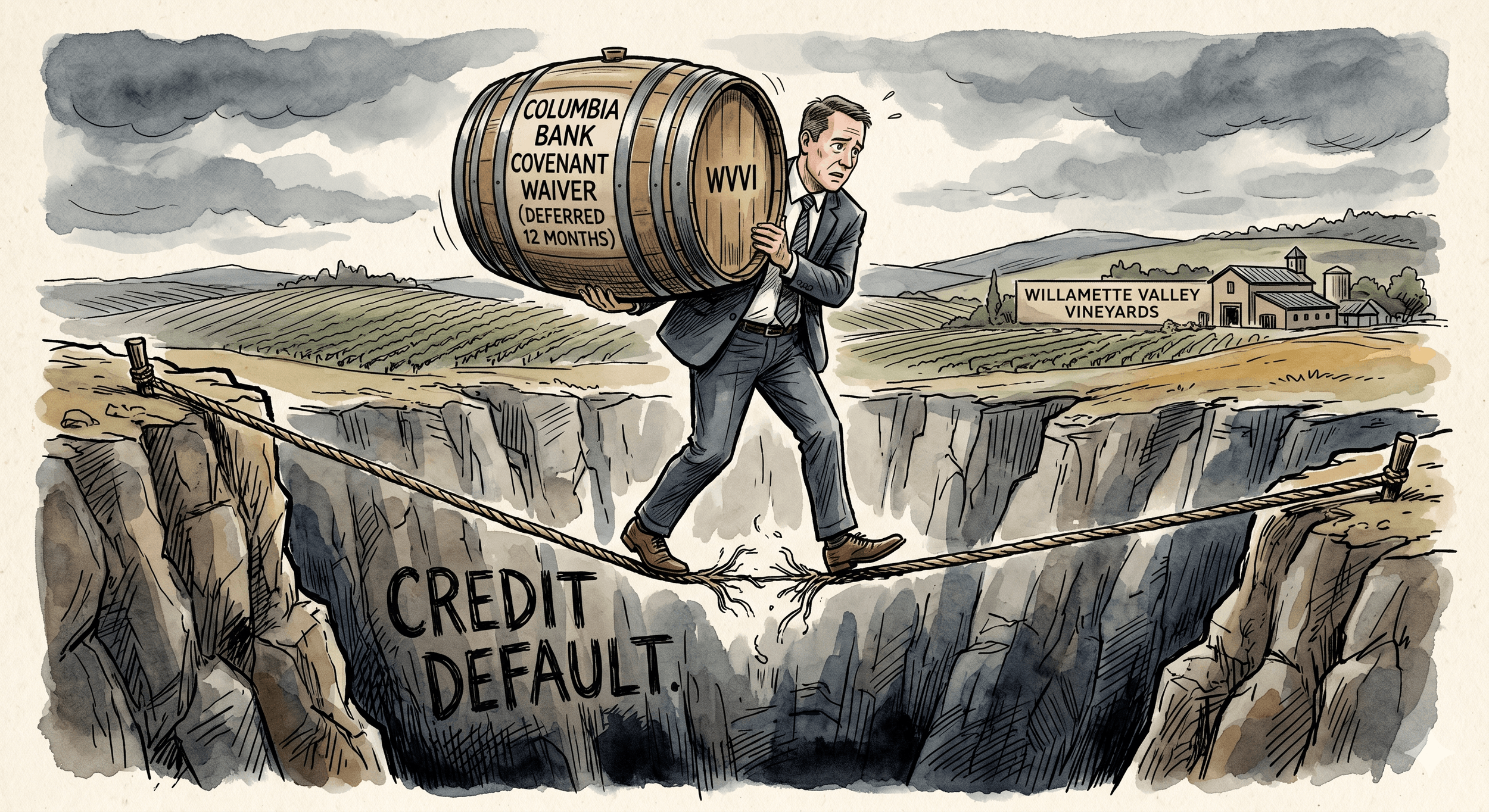
WVVI’s line of credit agreement with Columbia Bank requires compliance with financial covenants including minimum tangible net worth, debt-to-equity, and debt service coverage metrics, and the company disclosed that it was out of compliance with a debt covenant as of December 31, 2025. The company received a twelve-month waiver for that violation only until December 31, 2026, which means covenant pressure has been deferred, not eliminated.
That turns the RNDC issue from an operating concern into a financing concern. If receivables tied to distributor growth become slower to collect or impaired, WVVI could face a double hit: weaker working capital and tighter room under already-sensitive lending covenants. For shareholders, that is the real risk in the story — not just slower growth, but growth that may have been booked through a partner whose instability could feed directly back into WVVI’s liquidity position.
Bad Habits Die Hard
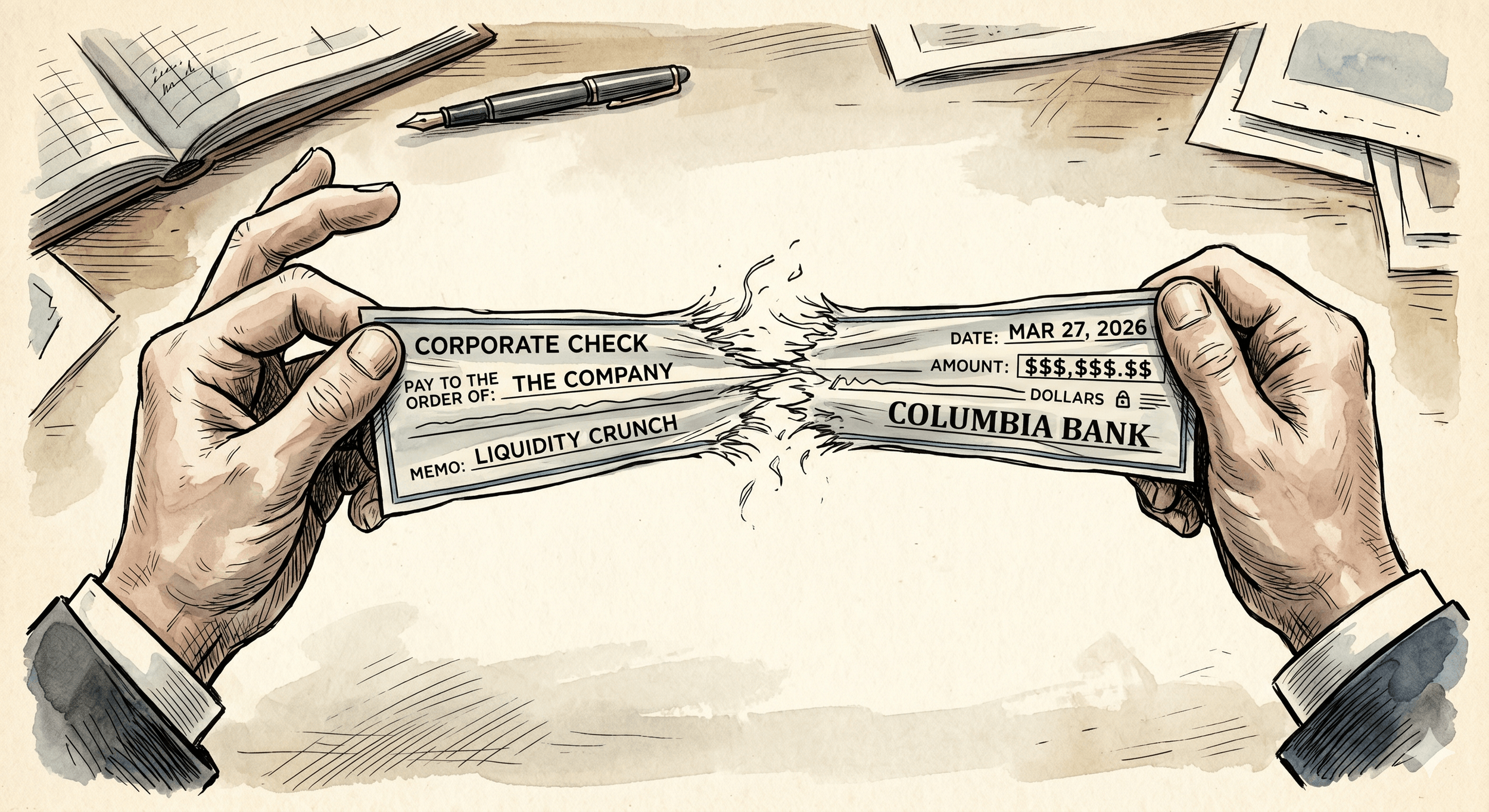
Not long after we released our first report on WVVI, the company conspicuously cleared their bank overdraft balance just in time for their 2025 annual report. The very next quarter and ahead of an upcoming change of the guard in CFOs effective May of this year, the company went right back to writing checks their bank couldn’t cash - treating the overdraft as though it was a (very expensive) line of credit. This was despite raising millions of dollars in a preferred share offering to investors that further diluted common equity holders.
Utilizing bank overdrafts is not standard practice for a healthy company, especially one that is subject to public reporting requirements. Typically, they are only tolerated when a company fundamentally fails to plan and properly organize its budget, or is otherwise in such dire and unexpected straits that they have no other option. In normal circumstances, a professionally managed company would at the very least be employing a short-term line of credit to prevent bank overdraft fees and interest. What makes this even more perplexing is the fact that WVVI clearly has access to such lending and yet chooses not to use it - their outstanding credit line is listed directly below the bank overdraft in their balance sheet reporting.
What Management Should Have Known
The charitable interpretation is that WVVI saw RNDC as the fastest route to broader East Coast placement and accepted the risk. The less charitable interpretation is that management either underestimated or ignored obvious warning signs in the distribution landscape, despite the fact that supplier exposure to a troubled distributor is one of the oldest and most predictable risks in the alcohol business.
Either way, the burden now falls on future disclosures. Investors should watch whether WVVI signals elevated bad-debt reserves, slower collections, further line-of-credit dependence, additional covenant waivers, or any softening in distributor sales after the initial Q1 lift. If the company’s distributor-led growth in early 2026 came with rising nonpayment risk, then the sales boost may prove far less valuable than it first appeared.
Preferred Equity Is Not Solving the Core Problem
WVVI’s own disclosure on page 13 of their 2025 annual report is unusually direct:
“The Company’s cash flow from operations historically has not been sufficient to provide all funds necessary for the Company’s operations. The Company has entered into two line of credit agreements to provide such funds and entered into term loan arrangements. There is no assurance that the Company will be able to comply with all conditions under its credit facilities in the future or that the amount available under its line of credit facility or capital raises will be adequate for the Company’s future needs. Failure to comply with all conditions of the credit facilities, or to have sufficient funds for operations could adversely affect the Company’s results of operations and stockholder value.”
That is not the language of a company using outside capital from a position of strength. It is the language of a company admitting that the balance sheet still depends on external support just to keep normal operations moving.
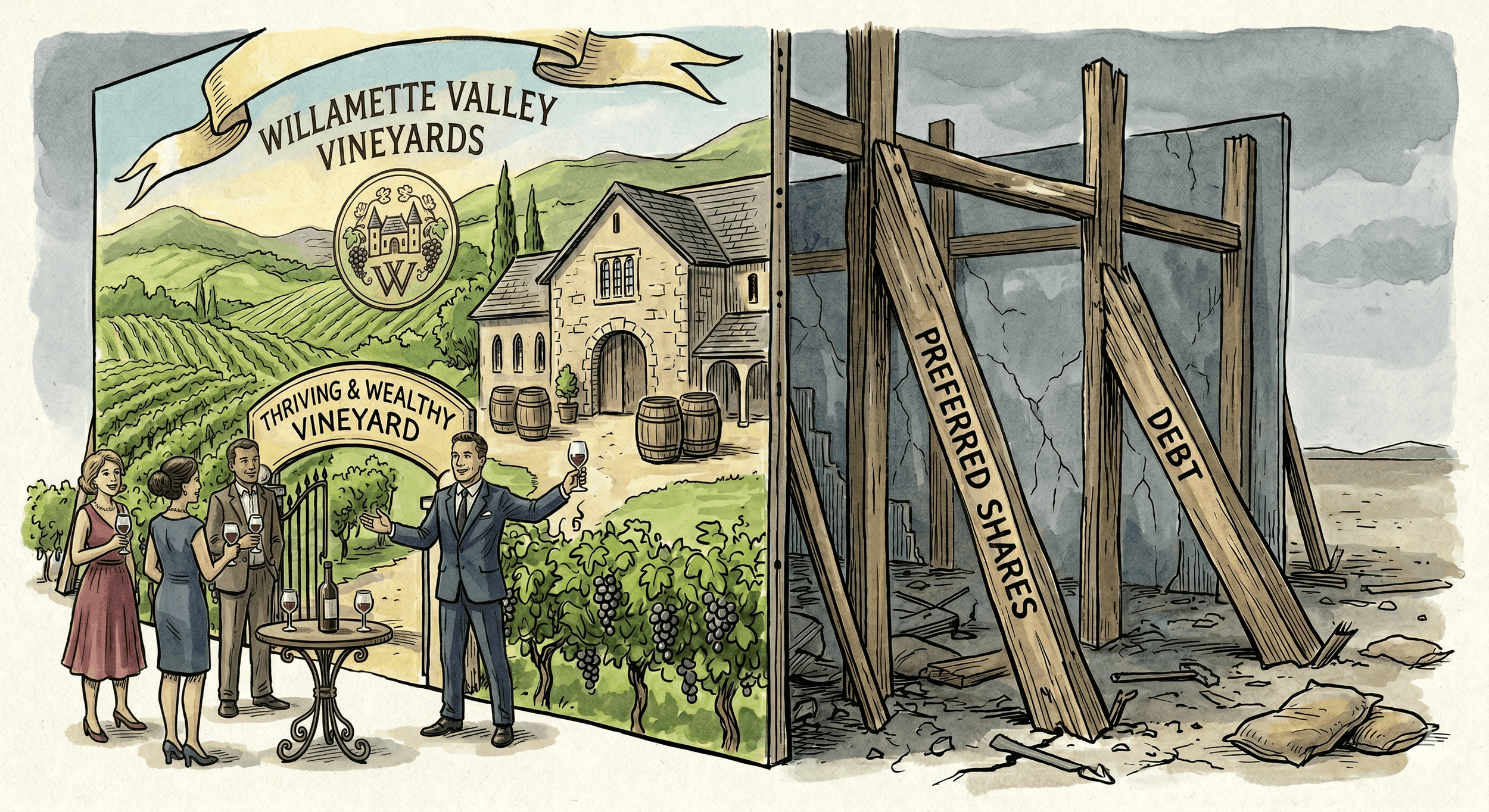
What makes the capital structure more troubling is the way WVVI appears to be leaning on preferred share issuance to patch over operating weakness rather than recapitalize the business cleanly. The company had $46.1 million of redeemable preferred equity outstanding at March 31, 2026, and its reported loss per common share is shown only after preferred dividends, highlighting how that security sits ahead of common holders in the economic stack. In substance, WVVI seems to be raising cash from preferred investors while common shareholders absorb the downside of an increasingly expensive and senior claim on the business.
The preferred dividend is especially important because it is not the same as a hard operating necessity. WVVI has publicly marketed the preferred stock with an annual cash dividend of $0.22 per share, and its investor materials continue to present that payout as a central feature of the security. But if liquidity pressure intensifies, preserving the preferred dividend may become less rational than preserving solvency, particularly for a company that has already disclosed uncertainty around future covenant compliance and funding adequacy.
That creates a real possibility that WVVI could cut or suspend the preferred dividend entirely before it risks a deeper credit event. Such a move would likely be painful for investor confidence, but it would still be more defensible than allowing cash to leave the business while lender risk is rising. From a capital-allocation standpoint, the company likely would have been better served by issuing more conventional common equity and accepting dilution up front, rather than layering on a security that increases fixed expectations without clearly solving the underlying cash-generation problem.
The danger now is that WVVI may have chosen the most shareholder-unfriendly middle ground: not enough internally generated cash to self-fund operations, not enough clean equity capital to de-risk the balance sheet, and a credit structure that can become restrictive if performance slips. If the company faces slower collections, weaker sales mix, or additional operating losses, the preferred dividend could become one of the first discretionary items sacrificed, and a credit facility default would no longer look remote.
Please note that the Woodworth Contrarian Stock & Bond Fund, LP, of which the Millegan Brothers manage and are invested in, do not currently hold a position of WVVI as of the publication date of this article. They may or may not choose to modify their exposure to this name for any reason at any time. This is not a recommendation to buy or sell WVVI or any other name - investments incur significant risk, our risk tolerance may be significantly higher than the average investor, and any discussion in this article does not take into consideration your individual circumstances.
Previous report on WVVI available here.
DEEP ROOTS. STUBBORN GROWTH. OREGON-BASED.
Now is a great time to diversify your portfolio with an investment into an award-winning fund. Call us or visit our website to inquire on an investment today in the Woodworth Contrarian Fund as an accredited investor.
(800) 651-1996 - info@woodworth.fund - www.Woodworth.Fund
Contrarian Value-Based Hedge Fund of the Year 2022-2024


Quinn Millegan (left) & Drew Millegan (right)
About the Managers: Brothers Drew Millegan and Quinn Millegan manage the Woodworth Contrarian Stock & Bond Fund, a hedge fund based in McMinnville, Oregon. They grew up in the finance world, and specialize in contrarian investment strategies in the US Public and Private markets.
Something missing from your portfolio may be a diversification into the Woodworth Contrarian Fund for accredited investors. Now is a great time to diversify your portfolio with an investment into a multi-award-winning fund. An exposure to a value-based contrarian strategy is a unique opportunity for your long term capital that you’re seeking aggressive returns for. With nine years of the Woodworth Fund under management, the Millegan Brothers are trained stock-pickers and experienced venture capital investors with a proven track record. Give us a call today to discuss a liquid investment with independent administration and independently audited monthly statements and a personal relationship.
