
WILLAMETTE VALLEY VINEYARDS (WVVI): The Man Behind the Curtain
Brought to you by The Woodworth Contrarian Fund

If a barrel of wine is worth more empty than full, what is a wine company worth when its survival depends on selling a fairy tale to unsuspecting retail investors?
Willamette Valley Vineyards (Nasdaq: WVVI) is a company teetering on the edge of a financial precipice. In our previous reports, we highlighted WVVI’s rapidly decaying balance sheet, the toxic reliance on preferred equity to plug operating holes, and the massive risks lurking in their distributor network. Our warnings have materialized.
Yet, rather than addressing the existential crises highlighted in the June 30, 2026 10Q, Chairman and President Jim Bernau, has chosen to double down on deception. At the July 2026 annual meeting, Bernau pitched a highly misleading narrative to sell more preferred stock, papering over covenant violations, bank overdrafts, and a disastrous $1.1 million write-down with the promise of a "destination resort" that is practically impossible to build under Oregon land use laws.
Here is why WVVI is a value trap where the common equity is effectively worthless.
The Destination Resort Deception
At the 2026 annual meeting, Jim Bernau excitedly announced his intention to finish his career by building an "iconic, yet approachable, wine, catering and lodging destination." He showcased AI-generated renderings of a main lodge and cabins, purportedly designed by Will Hawkins (an architect who is no longer actively practicing traditional architecture). He even invited shareholders to a groundbreaking on September 12, 2026, using this enthusiasm as a high-pressure sales pitch to push more Series A Redeemable Preferred Stock.
There is one massive problem: The project is not allowed by law.
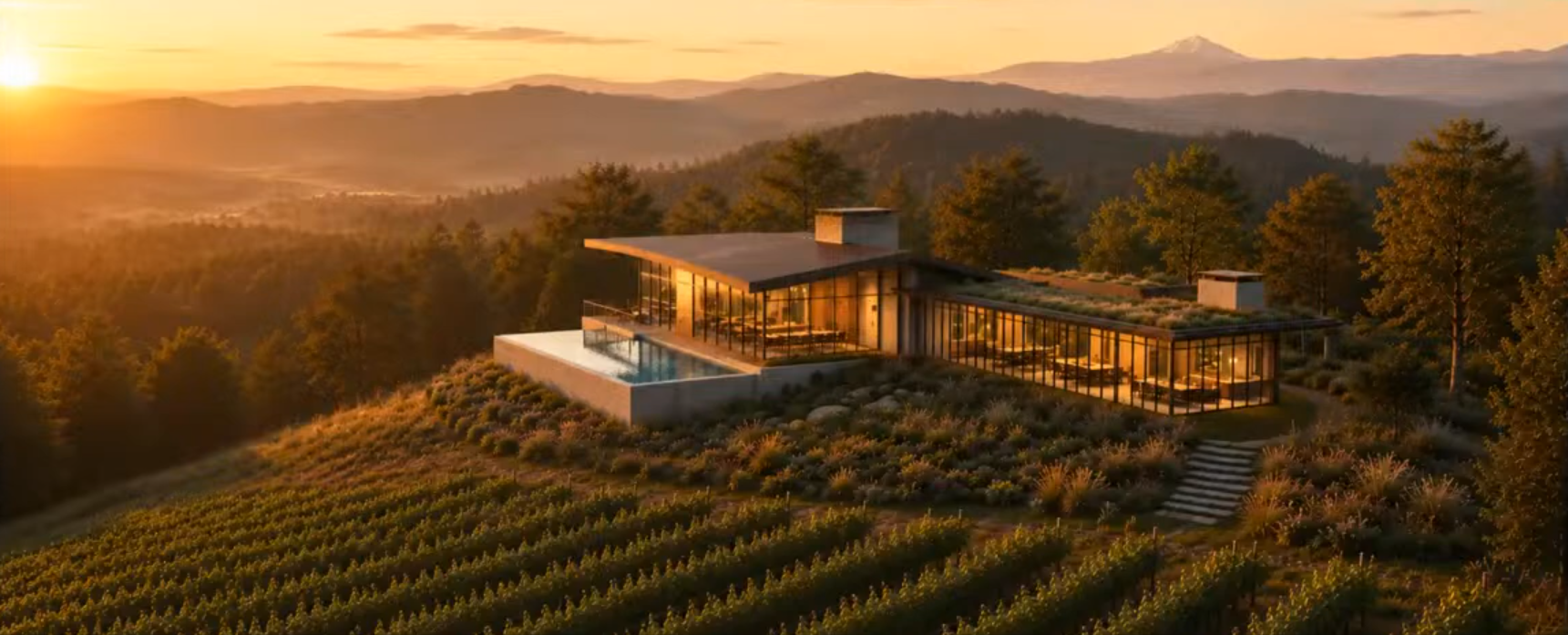
Resort Concept Image #1 - WVVI Annual 2026 Investor Presentation
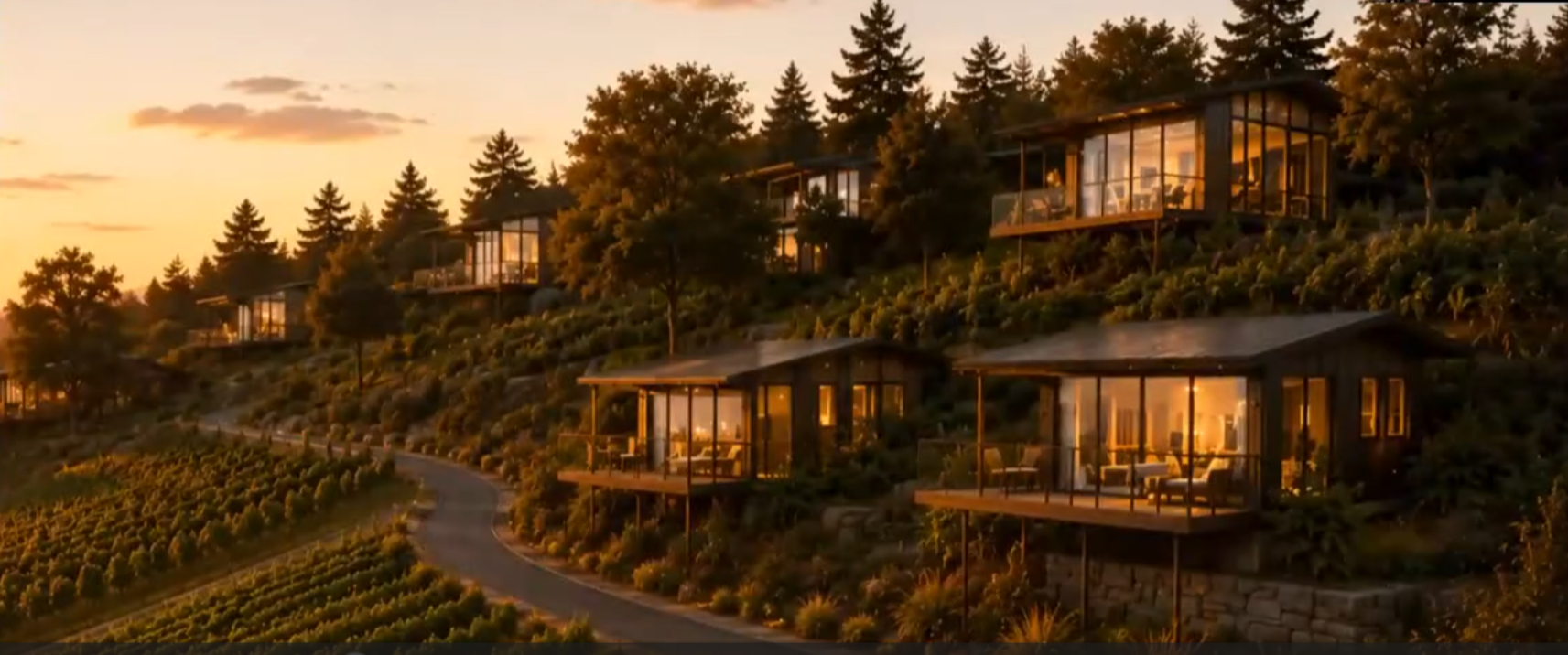
Resort Concept Image #2 - WVVI Annual 2026 Investor Presentation
WVVI recently burned $500,000 on this 48-acre property, which is zoned EFU (Exclusive Farm Use). To build a destination resort of this scale, WVVI would need to rezone the land to Farm/Forest and apply under Oregon's destination resort statutes (ORS 197.455).
The 25-Mile Rule: Under Oregon land use laws, a destination resort cannot be sited within 25 air miles of an urban growth boundary (UGB) with an existing population of 100,000 or more.
The Reality: The property is just over 1 mile from the Salem UGB with a population of 182,900. This prevents the development without applying for a major exception to Oregon Land use laws, which is highly unlikely to receive approval and would take years in a public process.
The Status: According to Marion County Planning, WVVI hasn't even applied for zoning or planning permission.
This isn't a visionary growth plan; it is a pipe dream designed to serve as a shiny object for retail investors. The real motive is evident in the recently filed prospectus supplement dated June 26, 2026, for the issuance of up to 555,555 shares of preferred stock to raise $1.75 million. Why? Because the company is out of cash.
Financial Reality vs. Management Spin
During his pitch, Bernau claimed WVVI possesses $100 million in assets, only $17 million in debt, and pointed out the common stock was trading at a paltry $13 million valuation (now closer to $11.5 million at $2.31/share). He claimed the preferred dividend "is not going down."
A quick dive into the Q2 2026 10-Q shatters this illusion:
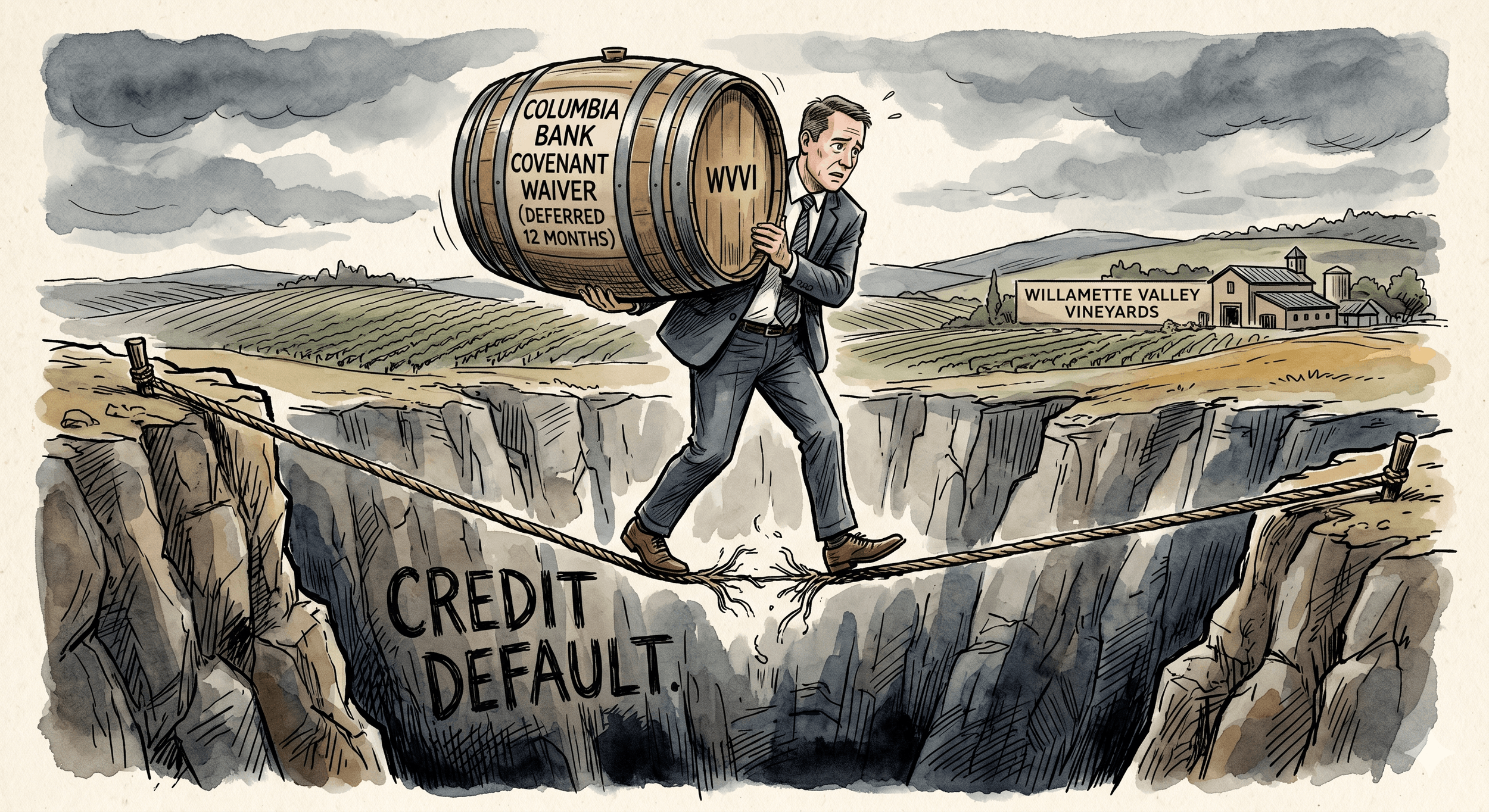
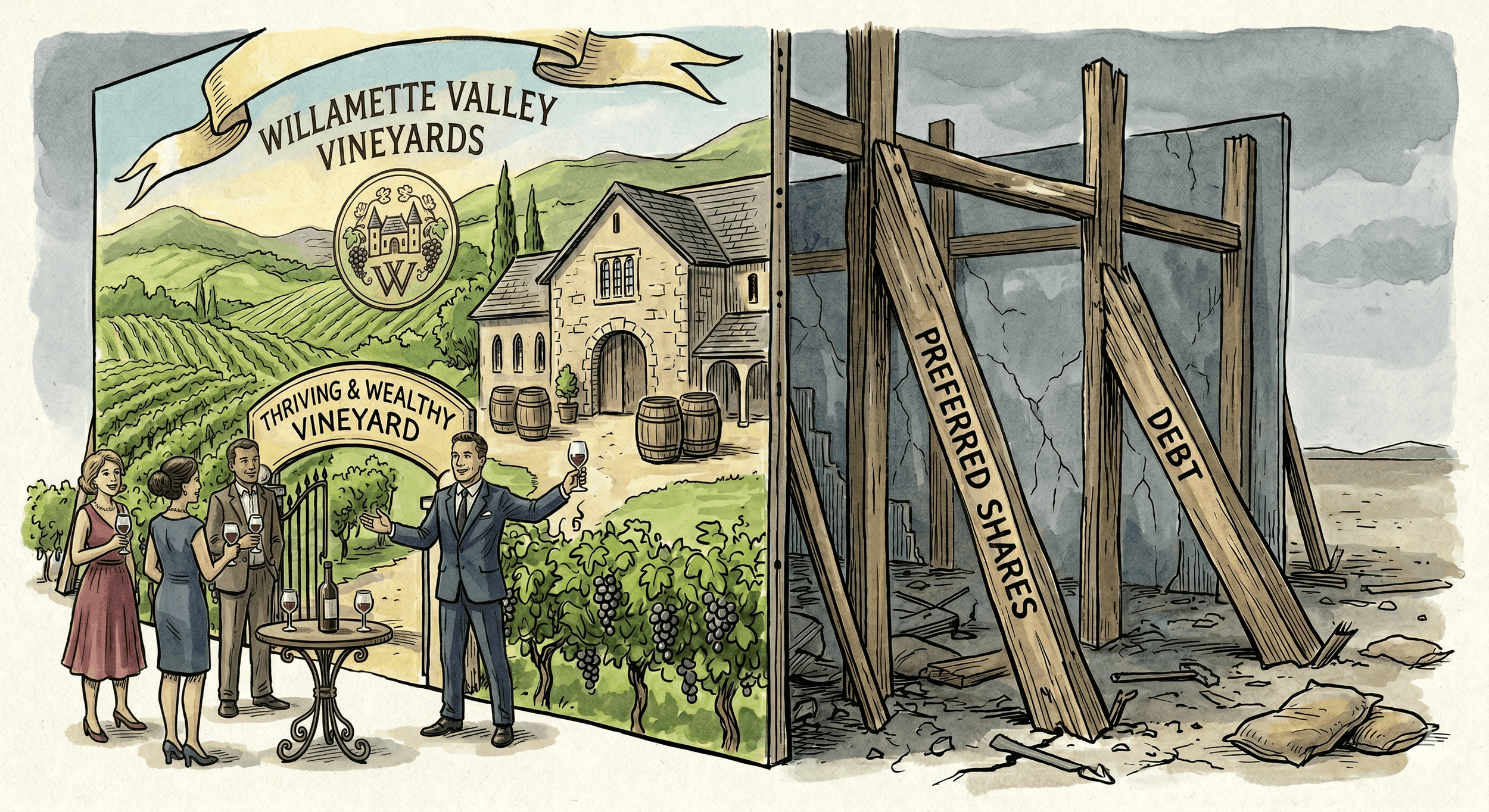
The "Only $17M in Debt" Lie: The company's true liabilities are upwards of $36.5 million. And while standard bank debt and leases are present, Bernau conveniently ignores the massive preferred stock burden. As of June 30, 2026, the liquidation preference of the outstanding preferred stock is $46,944,611. This preferred equity stands entirely in front of common shareholders in the event of liquidation.
The Liquidity Crunch: The company is chronically short on cash. They ended Q2 relying on a $534,488 bank overdraft to pay bills. This is a 119% increase in the bank overdraft recorded at the end of Q1 of $243,699.
Crushing Near-Term Debt: WVVI has $3,131,243 of long-term debt classified as current (due within the year). Given the company is cash flow negative, lacks appreciated refinanceable assets, even the issuance of new preferred stock is unlikely to meet this obligation.
Covenant Violations: As of December 31, 2025, WVVI was out of compliance with a Columbia Bank debt covenant. They are surviving on a temporary waiver that expires December 31, 2026.
Management's claim that the preferred dividend is safe is mathematically absurd. For the six months ended June 30, 2026, the company generated a net loss of $1,954,948. In that same period, they accrued $1,212,142 in preferred dividends. The loss applicable to common shareholders was a staggering $3,167,090. WVVI does not have the cash flow to pay the preferred dividend, a payment that is discretionary and not cumulative. You cannot pay dividends with negative cash flow and bank overdrafts.
It would be wise of WVVI to eliminate the dividend on the preferred stock.
The RNDC Bankruptcy: A Self-Inflicted Wound
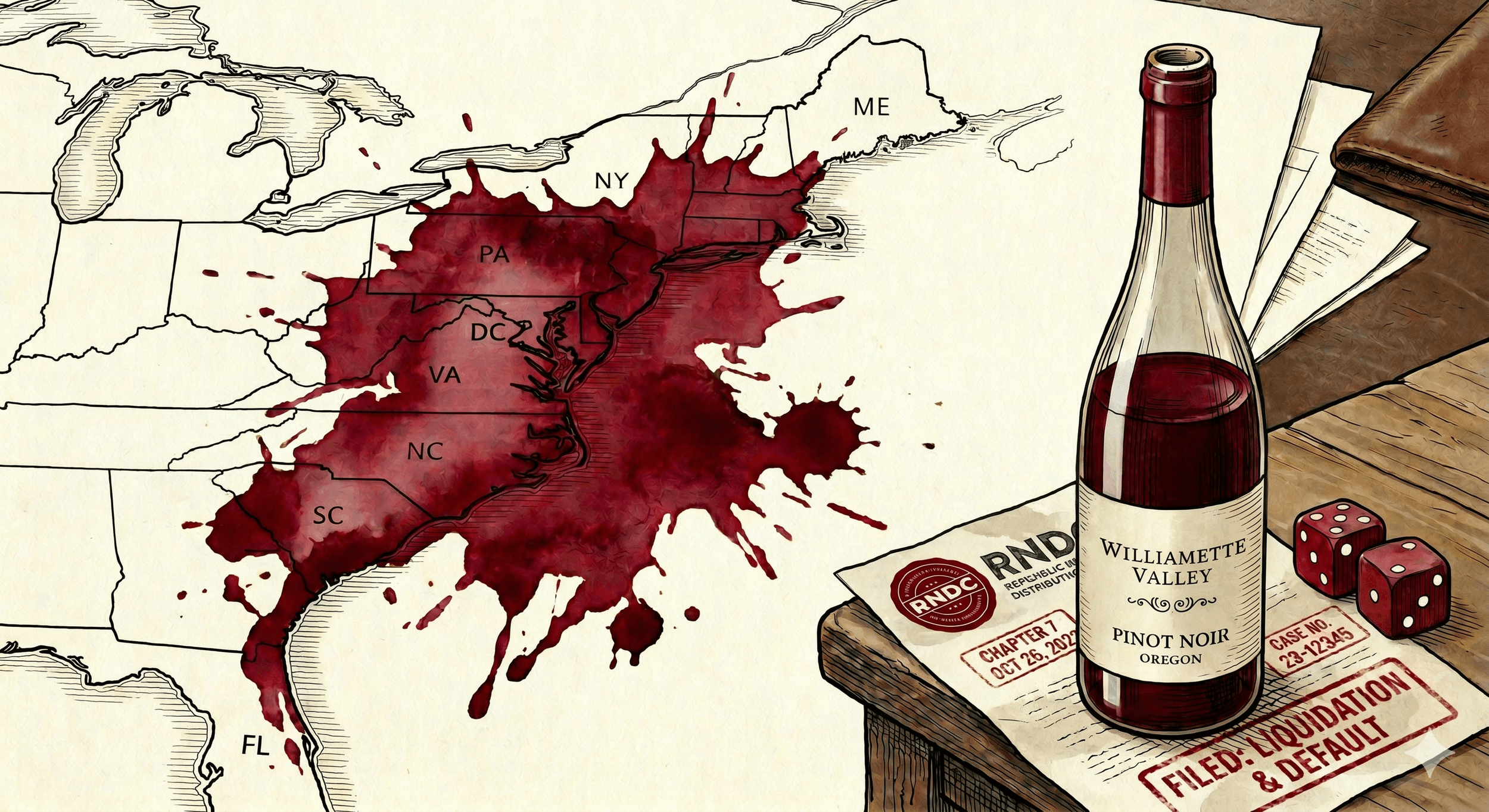
In our last report dated May 27, 2026, we explicitly warned about the receivables risk associated with WVVI’s unwise February 2026 switch in wholesale distribution to RNDC by the new CEO Michael Osborn. On July 26, 2026,four months later, Republic National Distributing Company (RNDC) filed for Chapter 11 bankruptcy, an event that was easily foreseeable.
The fallout was immediate and brutal. WVVI had to increase its allowance for credit losses by approximately $1.1 million in Q2. This completely obliterated their operating margins. Selling, general, and administrative expenses spiked 22.5% to $7,127,694 for the quarter. Management is trying to pivot deeper into Wholesale (Distributor Sales increased to $4.8 million in Q2), a channel with fundamentally lower margins than their Direct-to-Consumer (DTC) segment. Meanwhile, their high-margin DTC sales actually shrank from $5,497,973 in Q2 2025 to $5,235,480 in Q2 2026.
Despite this disastrous distributor decision, the company still employs Michael Osborn as an east coast based CEO. At a salary of over $400,000, this roughly doubles their chief executive salary costs with no obvious benefit - since the company quietly retained Jim Bernau at $400,000+ as President & Principal Executive Officer even though Michael was his supposed successor.
Liquidation Value: The Common is a Zero
If we strip away the accounting mechanics and look at a true liquidation scenario, the common equity is likely underwater.
| Balance Sheet Item | Stated Value (Q2 2026) | The Reality Check |
|---|---|---|
| Total Assets | $102,949,977 | Includes bloated inventory and capitalized leases. |
| Total Liabilities | $36,532,093 | Real, hard obligations. |
| Preferred Stock (Liquidation Pref) |
$46,944,611 | Senior to common equity; continues to grow. |
| Implied Common Equity | $19,473,273 | Highly theoretical. |
The Inventory Problem: WVVI holds $31,517,284 in inventory (wine and materials). In a declining wine market where supply wildly outpaces demand, moving this volume at book value is nearly impossible. If this inventory is impaired by even 30-40% to clear it out, the entirety of the common equity vanishes.
The Real Estate Mirage: Investors assume WVVI is asset-rich in real estate. But management already mortgaged the future with debt on the main winery and via sale-leaseback agreements on prime properties (like Tualatin Vineyards in 1999 and 2004). The company recognized $10,383,516 in operating lease right-of-use assets against $11,134,331 in total operating lease liabilities. The ability to extract fresh capital from real estate is exhausted. In addition, the lease back payments were negotiated when vineyard values were much higher than now. It would be difficult to get any value from unloading these above market leases.
The Man Behind the Curtain: At the July 2026 annual meeting, Jim Bernau continued to pitch investors and their families to buy the new ”limited” preferred stock offering beginning August 1st at $3.45 a share at a “favorable price.” This was much higher-priced than investors could buy WVVI preferred for on the open market (currently at $2.54 or 22% lower). Bernau states that, "people see the trading price for the preferred stock and do not fully understand it” and that “only a few trades on NASDAQ it is not representative of the value of the company” claiming that “the value of the company is far greater.” Bernau goes on to tell investors that the preferred “includes a dividend that is not going down,” and does not include the added 15% credit if converted to goods at the winery. What Bernau leaves out is that preferred shares in the open NASDAQ market also includes the potential for the 15% conversion. This privately offered preferred stock offers no clear benefit, as compared to simply buying equivalent shares at a lower cost in the open market.
Conclusion
Willamette Valley Vineyards is not suffering merely from a weak wine market; it is suffocating under the weight of poor management, disastrous strategic decisions, and a board that prioritizes covering up the truth over fiduciary duty. Jim Bernau’s 2026 annual meeting presentation was a masterpiece in misdirection—peddling a prohibited “destination resort” to distract from bank overdrafts, debt covenant violations, and a crushing preferred stock burden.
We reiterate our stance: Avoid WVVI stock at all costs. The underlying financials suggest a company on a direct path to insolvency, propped up solely by the continued extraction of cash from retail investors via preferred equity offerings.
Please note that the Woodworth Contrarian Stock & Bond Fund, LP, of which the Millegan Brothers manage and are invested in, do not currently hold a position of WVVI as of the publication date of this article. They may or may not choose to modify their exposure to this name for any reason at any time. This is not a recommendation to buy or sell WVVI or any other name - investments incur significant risk, our risk tolerance may be significantly higher than the average investor, and any discussion in this article does not take into consideration your individual circumstances.
Previous reports on WVVI available here:

DEEP ROOTS. STUBBORN GROWTH. OREGON-BASED.
Now is a great time to diversify your portfolio with an investment into an award-winning fund. Call us or visit our website to inquire on an investment today in the Woodworth Contrarian Fund as an accredited investor.
(800) 651-1996 - info@woodworth.fund - www.Woodworth.Fund
Contrarian Value-Based Hedge Fund of the Year 2022-2026


Quinn Millegan (left) & Drew Millegan (right)
About the Managers: Brothers Drew Millegan and Quinn Millegan manage the Woodworth Contrarian Stock & Bond Fund, a hedge fund based in McMinnville, Oregon. They grew up in the finance world, and specialize in contrarian investment strategies in the US Public and Private markets.
Something missing from your portfolio may be a diversification into the Woodworth Contrarian Fund for accredited investors. Now is a great time to diversify your portfolio with an investment into a multi-award-winning fund. An exposure to a value-based contrarian strategy is a unique opportunity for your long term capital that you’re seeking aggressive returns for. With nine years of the Woodworth Fund under management, the Millegan Brothers are trained stock-pickers and experienced venture capital investors with a proven track record. Give us a call today to discuss a liquid investment with independent administration and independently audited monthly statements and a personal relationship.
