
Brought to you by The Woodworth Contrarian Fund
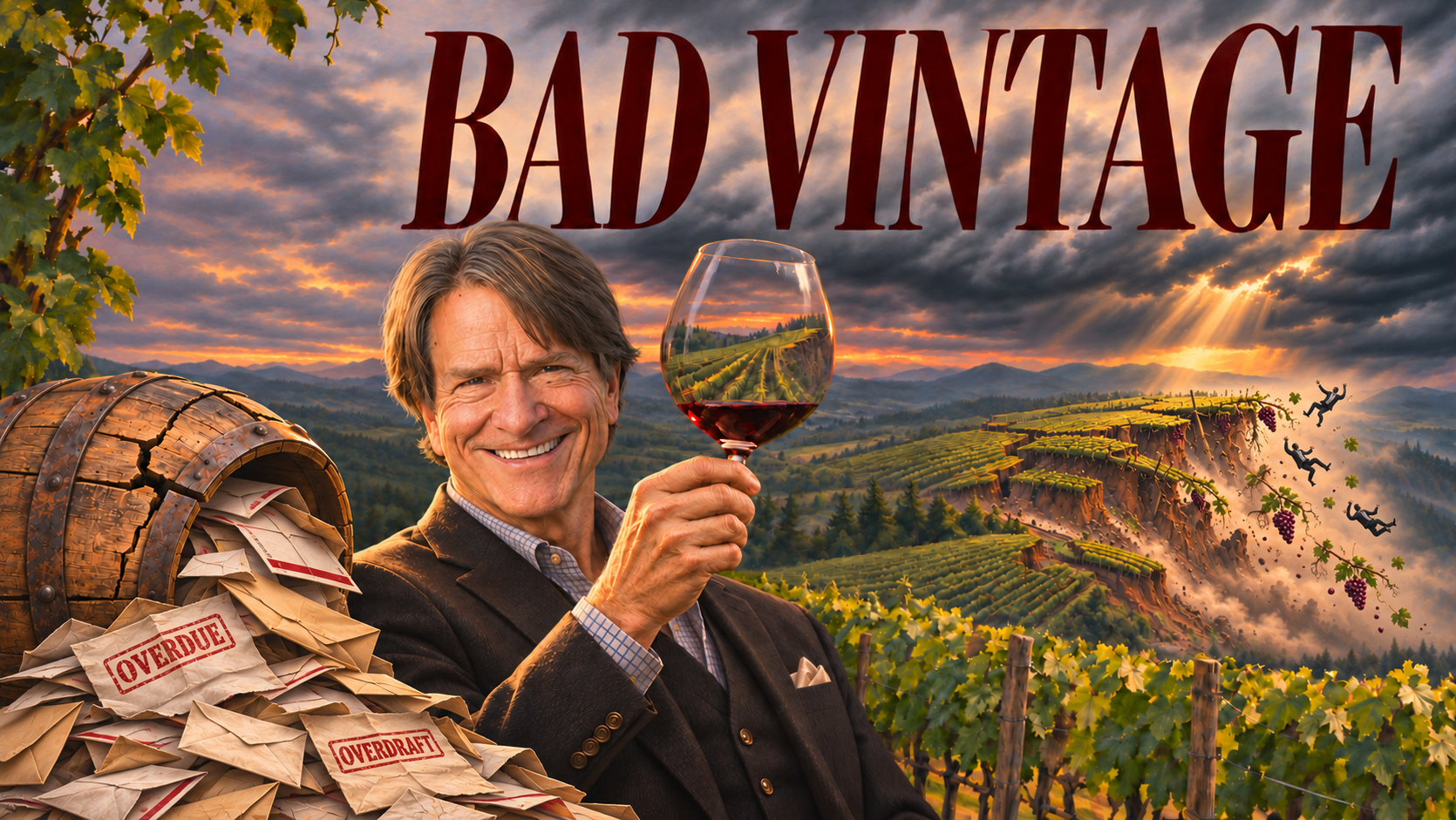
Willamette Valley Vineyards (NASDAQ: WVVI & Preferred WVVIP) remains on a direct path to insolvency. While management's narrative points to stabilizing revenues, a forensic year-over-year (YoY) analysis of the Q3 2026 SEC filings reveals a fundamentally distressed company. The underlying financials demonstrate a failure to control costs, a deteriorating liquidity profile masked by vendor stretching, and a catastrophic capital allocation strategy. We reiterate our stance: WVVI is not a viable investment, and its common equity remains highly toxic.
1. The Liquidity Crisis & Operational Failures
Management has failed to arrest the company's cash burn, heavily relying on debt and delayed payments to maintain basic operations.
Continued Bank Overdrafts: The company's reliance on overdrafts is not a temporary anomaly but a worsening structural crutch. The bank overdraft surged to $830,533 in Q3 2026, a significant deterioration from the $600,291 overdraft reported in Q3 2025.
Surging Net Losses (YoY): While Q3 net loss was relatively flat YoY (-$1,050,820 in Q3 2026 vs.-$1,092,450 in Q3 2025), the YTD picture is disastrous. Net loss for the nine months ended September 30, 2026 was -$3,005,769, a 73.9% deterioration compared to the -$1,728,636 loss in the same period of 2025.
High-Margin Sales Collapse: Direct-to-consumer (DTC) sales— which is the high-margin lifeblood of the company according to Jim Bernau—fell YoY by $289,200 for the nine months. DTC margins sit at 52.1% versus 47.9% for wholesale. The story-selling model is failing where it matters most, mirroring the macro trend where wholesale-focused estate wineries are under the most pressure.
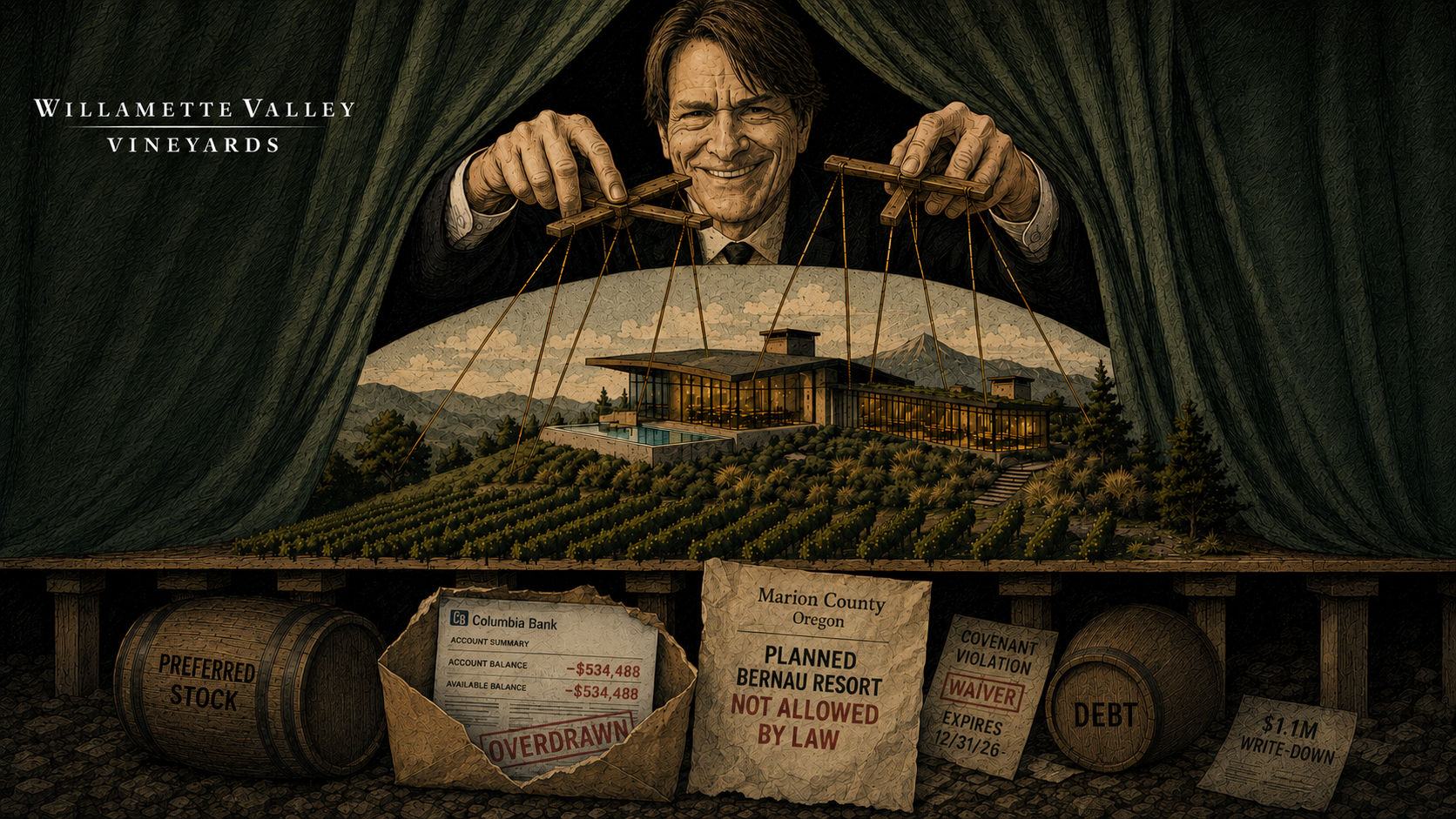
The Debt Covenant Cliff: WVVI explicitly admits it was "out of compliance with a debt covenant" with Columbia Bank as of December 31, 2025. The covenant requires them to maintain minimum amounts of tangible net worth and debt service coverage. Columbia Bank granted a temporary waiver for this violation, but that waiver expires on December 31, 2026. In recent calls and despite the approaching deadline for this, management has remained conspicuously silent on how they plan to deal with this.
Escalating Debt Payments: Of the $14.4 million in long-term debts that the company owes, $3.1 in minimum payments are coming due in 2027 alone. This is over three times the size of the long-term debt payments owed in 2026.
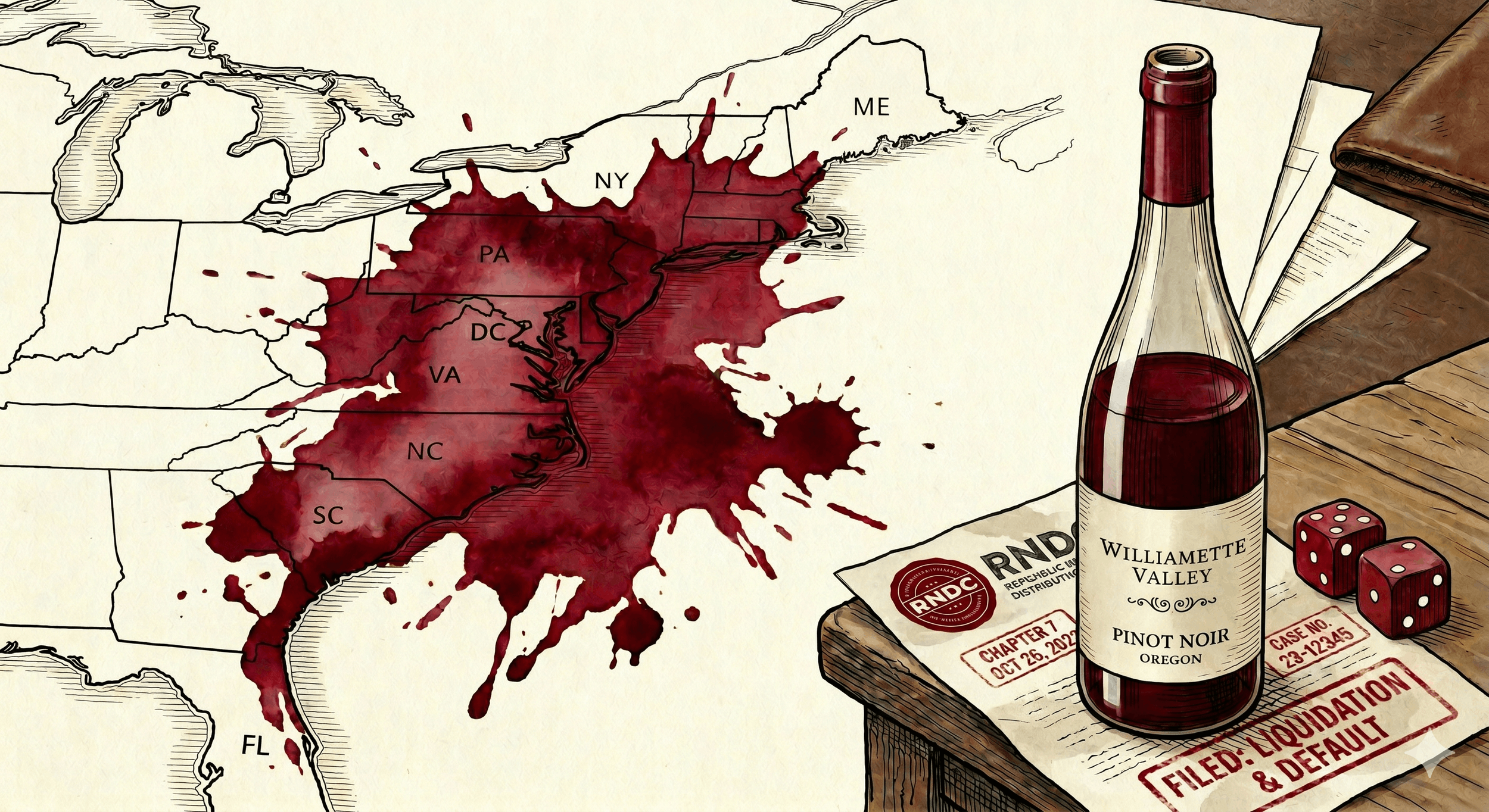
Failure to Pull Back SG&A: Despite previous pledges of cost reductions, spending is accelerating. Selling, general, and administrative (SG&A) expenses for the first nine months surged to $19,265,167, up roughly $1.6 million from $17,665,039 in the same period last year. Even when backing out the $1.07 million non-cash credit loss provision from the Republic National Distributing Company (RNDC) bankruptcy, baseline operating expenses are still climbing against a backdrop of severe industry headwinds.
Stretching Accounts Payable: WVVI is surviving by squeezing vendors. Accounts payable ballooned to $2,779,554 in Q3 2026, a massive 79.6% YoY increase from $1,546,997 in Q3 2025.
2. Capital Misallocation in a Collapsing Industry
The broader West Coast wine market is in a structural crisis, yet WVVI continues to spend as if it is operating in a boom cycle.
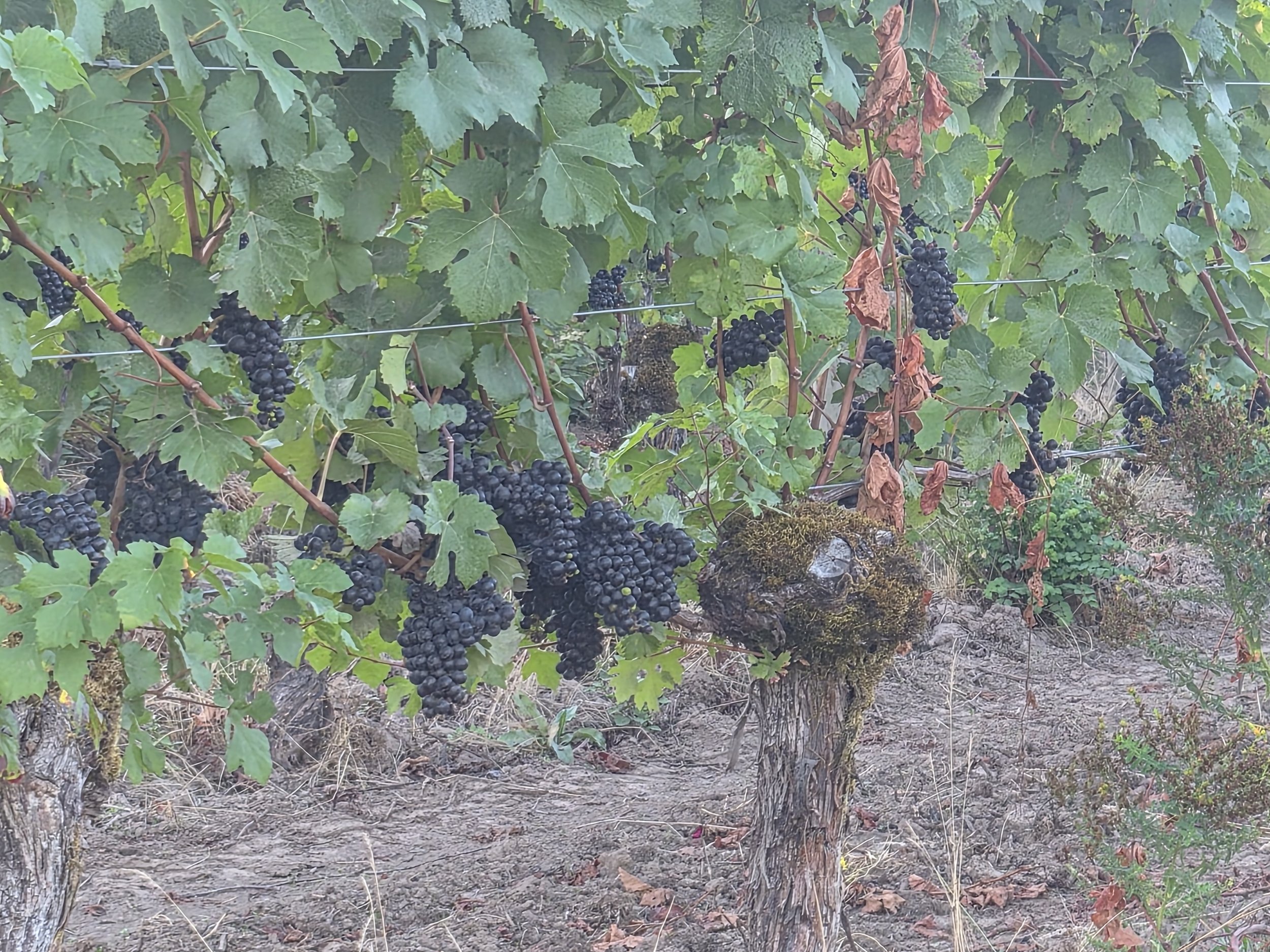
Domaine Willamette Grapes unpicked as of September 2026 (Woodworth Contrarian 2026)
The Oregon & Napa Gluts: In Oregon, 2025 wine grape production dropped 25% to just over 97,000 tons. A staggering 61% of local winegrowers left vineyards unharvested or partially harvested, and 71% of those couldn't find buyers for their grapes. Overall Oregon wine sales by case dropped 16%. In Napa, experts warn that supply and demand will not return to balance before 2029, and vineyard removals are running above the historical norm of 3% to 4% due to weak demand.
Wasteful Expansion: While the industry rips out vines, WVVI is carrying $8,544,737 in vineyard development costs. Construction in progress ballooned year-over-year from $626,890 in Q3 2025 to $1,021,417 in Q3 2026. Expanding physical footprints—likely tied to the unpermitted resort project on the eastern slopes—is a catastrophic misallocation of shareholder capital when 48% of Oregon growers sold grapes at or below cost in 2025.
Trapped in Escalating Leases: WVVI's properties are either heavily encumbered or locked in sale-leasebacks. These operating leases carry escalation provisions tied to CPI (capped at 2% to 4% per year). While vineyard values collapse globally, WVVI’s fixed baseline costs are contractually guaranteed to rise.
Buying Grapes in a Glut: Despite the market glut, WVVI is actually buying more grapes. Grapes payable sits at $756,721, a year-over-year increase of $198,868 compared to the $557,853 reported in Q3 2025.
Inventory Bloat: The average client winery in the West Coast held 4.1 years of inventory in 2025. WVVI is no exception. Bernau claimed the remaining challenge is bringing "finished wine inventories back into balance," yet total inventory remains virtually unchanged at a massive $32,823,025 in Q3 2026. While management might point to a marginal year-over-year decrease from $34,267,179 in Q3 2025, the internal inventory mix is deteriorating. Year-to-date, finished goods have actually increased from $15,869,702 at year-end to $17,281,282.
4. The Preferred Stock Trap
WVVI’s reliance on retail investors funding its Series A Preferred Stock (WVVIP) has become a death spiral.
The Valuation Gap: WVVI carries 11,022,522 shares of preferred stock on its balance sheet at an issuance value of $47,318,197. However, with WVVIP trading near $2.94 on the open market, the actual market value of this preferred equity is approximately $32.4 million. This nearly $15 million gap severely overstates the economic book value of the company to retail investors.
Unsustainable Dividend Costs: The cash drain is accelerating. Accrued preferred dividends for the first nine months hit $1,818,213, up YoY from $1,689,530.
The Retail Well is Dry: The company’s latest attempt to raise $1.75 million through preferred stock sales yielded a meager $85,323 in proceeds for the quarter. Investors are finally realizing there is no reason to buy shares directly from the company for over $4.00 when they can buy them on the open market for under $3.00. The company continues to drain cash to service accrued preferred dividends, which hit $1,818,213 for the first nine months of 2026. The unearned revenue associated with unused dividend gift cards has dropped from $2,031,377 at year-end 2025 to $1,466,397, signaling that investors are demanding cash over wine discounts.
The Bottom of the Barrel’s Dregs
The reality of WVVI’s decline is reflected in the continued decline of their common stock, having plummeted a further 17% to $1.73 per share from our last report. For context, stocks typically face danger of delisting from major exchanges if they spend very long under $1/share. While WVVI isn’t quite there yet, the stock is within reasonable spitting distance of this mark without much evidence of a turnaround. Should this occur, public shareholders could eventually be “locked in” to their positions without the major liquidity of a publicly traded symbol, even if the company manages to hold on as an operating business.
The company’s preferred shares under symbol WVVIP, for what it’s worth, have held up better and actually increased slightly to $2.92 per share, likely due to their senior position in the event of a default. Though the company has so far continued to declare the dividend on these shares, it is clear that the company needs to start cutting expenses in a big way to avoid closing the cellar doors for good. As they say, buyers beware, although the discounted preferred shares in the public market are certainly a better deal with a higher yield than buying directly from Willamette Valley Vineyards.
We reiterate our stance: Avoid WVVI and WVVIP. The underlying financials suggest a company on a direct path to insolvency, which can’t even be propped up by the continued extraction of cash from retail investors via expensive preferred equity offerings. As lending rates rise, we expect this situation to get worse.
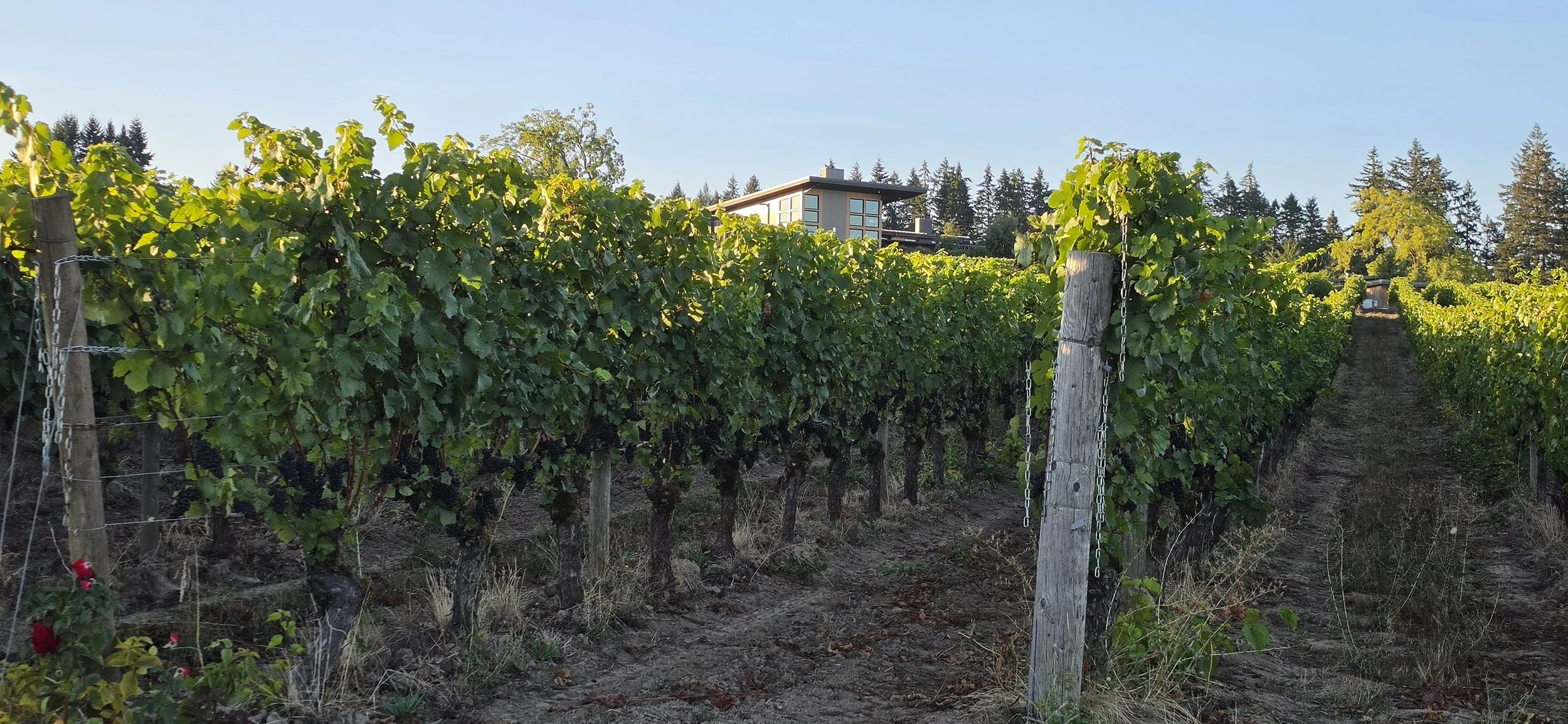
Domaine Willamette in September 2026 (Woodworth Contrarian 2026)
Please note that the Woodworth Contrarian Stock & Bond Fund, LP, of which the Millegan Brothers manage and are invested in, do not currently hold a position of WVVI as of the publication date of this article. They may or may not choose to modify their exposure to this name for any reason at any time. This is not a recommendation to buy or sell WVVI or any other name - investments incur significant risk, our risk tolerance may be significantly higher than the average investor, and any discussion in this article does not take into consideration your individual circumstances.
Previous reports on WVVI available below:

DEEP ROOTS. STUBBORN GROWTH. OREGON-BASED.
Now is a great time to diversify your portfolio with an investment into an award-winning fund. Call us or visit our website to inquire on an investment today in the Woodworth Contrarian Fund as an accredited investor.
(800) 651-1996 - info@woodworth.fund - www.Woodworth.Fund
Contrarian Value-Based Hedge Fund of the Year 2022-2026


Quinn Millegan (left) & Drew Millegan (right)
About the Managers: Brothers Drew Millegan and Quinn Millegan manage the Woodworth Contrarian Stock & Bond Fund, a hedge fund based in McMinnville, Oregon. They grew up in the finance world, and specialize in contrarian investment strategies in the US Public and Private markets.
Something missing from your portfolio may be a diversification into the Woodworth Contrarian Fund for accredited investors. Now is a great time to diversify your portfolio with an investment into a multi-award-winning fund. An exposure to a value-based contrarian strategy is a unique opportunity for your long term capital that you’re seeking aggressive returns for. With over ten years of the Woodworth Fund under management, the Millegan Brothers are trained stock-pickers and experienced venture capital investors with a proven track record. Give us a call today to discuss a liquid investment with independent administration and independently audited monthly statements and a personal relationship.
