
LANDS’ END (LE): A TYPO, A TURNAROUND, AND ONE HELL OF A BARGAIN
Brought to you by The Millegan Brothers & The Woodworth Contrarian Fund

While the broader equity markets are wildly pumping to dizzying new highs and terrified retail investors cower on the sidelines clutching cash, we are charging headfirst into a mind-bogglingly juicy contrarian bet: Lands’ End (LE). Yeah, that catalog company your grandparents bought fleece vests from. Trading at a dirt-cheap ~$10—criminally below its tangible book value of $16.42—this iconic retail beast is executing a ferocious, high-octane balance sheet makeover. Fueled by forward-looking execution and a game-changing private equity deal, Lands’ End is the ultimate under-the-radar value rocket. We think this stock is insanely undervalued right now: our short-term price target is $16, and our long-term moonshot target is $25 per share.
And here's a little history lesson that makes this opportunity even more interesting. Lands’ End wasn't born in some corporate boardroom—it started in 1963 when Gary Comer, a former advertising copywriter and competitive sailor, began selling sailing equipment out of a basement in Chicago. Even the company's name is a glorious accident: its first catalog mistakenly printed "Lands’ End" instead of "Land’s End," and the fledgling business was too broke to afford a reprint. So the typo stuck, becoming one of the most recognizable names in American retail. By the late 1970s, the company had traded sailboat rigging for rugby shirts, transforming itself into a mail-order powerhouse famous for quality clothing, legendary customer service, and those catalogs that seemed to arrive in every American mailbox. And here's the kicker: Lands’ End was an e-commerce pioneer, launching its online store in 1995, when most Americans barely knew what the internet was. Sears eventually snapped it up in 2002, before spinning it back into an independent public company in 2014. More than six decades, multiple reinventions, and one stubbornly misplaced apostrophe later, this iconic American brand is still standing. Wall Street apparently thinks its best days are behind it. We'd suggest they take another look at the history books.
One legendary typo. One $300 million deal. Five interactive ways to explore our LE turnaround thesis.
Drag the entry price to see what you would pay against reported book value and our targets.
Market price equals 61% of reported book.
*Book is an accounting figure, not a liquidation floor or guaranteed value. It includes an equity-method investment in the brand JV. Targets are estimates, not forecasts.
Select any metric to compare the two quarters. Green doesn't always mean the whole story is green.
+2.7% year over year
Revenue grew 2.7% year over year.
Brand monetization cut debt dramatically, but the royalty bill and share deals have important fine print.
WHP bought a controlling 50% interest in a brand-IP joint venture; Lands’ End retained the other 50%.
Most of the proceeds paid off the term loan, helping drive quarterly interest expense sharply lower.
The operating business licenses the brand back; royalties and possible JV distributions both matter.
DON'T CONFUSE THESE TWO $100M HEADLINES
WHP paid existing shareholders $45/share. That cash did not enter Lands’ End's treasury.
Separate repurchase authorization through March 2029; not an immediately completed $100M buyback.
Experiment with an entry price and an exit scenario. Same entry price as the Value gap tab.
At $10.00 in and $16.00 out. No probability or holding period implied.
Choose a chapter in the Lands’ End story—long before today's LE ticker.
Gary Comer launches a Chicago sailboat-equipment catalog. The first catalog misplaces the apostrophe, and Lands’ End can't afford a reprint.
The brand was born from a bargain—not a branding agency.
Q2 2026 Earnings: Absolute Fireworks Year-over-Year
Forget the naysayers—Lands’ End’s Q2 2026 earnings report ripped through low expectations with massive operational wins across the board compared to last year:
Revenue Acceleration: Net revenue surged to a cool $302.0 million in Q2 2026, marking a slick 2.7% year-over-year jump from $294.1 million in Q2 2025. The real juggernaut? US eCommerce ripped 9.0% higher YoY to hit $182.4 million.
Monster Margin Expansion: Gross profit blew up to $157.0 million, exploding gross margins by a jaw-dropping 320 basis points to 52.0% (up from 48.8% in Q2 2025).
Back in Black (And Loving It): The company flexed a positive net income of $3.5 million ($0.11/share), obliterating the dismal $3.7 million net loss ($0.12/share) from the prior year. Even when you strip out tariff recovery perks of $24.9 million alongside adjustments for other one-off noise, they still pulled in a solid $2.7 million ($0.09/share) in adjusted net income, completely flipping the $1.1 million net loss ($0.04/share) from last year’s quarter.
Obliterating Interest Expenses: Thanks to an aggressive debt-paydown campaign, Q2 interest expenses didn’t just drop—they cratered to a mere $1.0 million, down from a crushing $9.3 million the year before.
Sure, adjusted EBITDA dipped 25% YoY to $11.3 million, but make no mistake: the triumphant return to net profitability and beastly margin gains prove that this core retail machine is locked, loaded, and stabilizing fast.
The WHP Global Masterstroke: A Total Balance Sheet Metamorphosis
The single most epic catalyst for Lands’ End this year was its brilliant joint venture maneuver with brand management titan WHP Global. Finalized in early 2026 and backed by heavy-hitting private equity players, Lands’ End spun its intellectual property into a fresh joint venture. In exchange, WHP Global handed over a staggering $300 million in cold, hard cash for a 50% controlling stake of the joint venture. The beauty? Lands’ End keeps full rights to any future equity upside in the JV while retaining total control over its operational distribution machine.
This cash injection was pure magic. By monetizing its IP, Lands’ End viciously torched its mountain of debt right when skyrocketing interest rates started suffocating its competitors. Today, Lands’ End runs its daily operations and global e-commerce empire seamlessly, all while cruising with a clean, heavily deleveraged balance sheet.
And check out this wild, wildly overlooked feature of the deal: WHP Global raised and pumped another $100 million directly into Lands’ End equity (7% of the company) at an eye-watering valuation of $45 per share. For a stock that hasn’t smelled anywhere near $45 in four years, that is an unbelievable vote of confidence from smart money. Lands’ End management immediately put that capital to work, deploying a matching $100 million buyback program that effectively sucked shares right off the open market—massively shrinking total share count without burning a single dime of their own operational cash.
Valuation & Multiples: Ridiculously Cheap Bargain Territory
Now that the debt anchor has been sliced away, Lands’ End is sitting on the market’s discount rack, trading at a hilarious haircut relative to its intrinsic value, earnings potential, and long-term upside.
Debt to Equity Slashed: Post-WHP deal, total debt stands at a tiny $76.67 million against a mammoth book value of over $492 million. That drops their debt-to-equity ratio to a squeaky-clean 16%! Furthermore, most of that debt sits safely inside a long-term ABL credit facility ($60 million) rather than volatile short-term borrowings.
Price-to-Earnings Mispricing: Sure, LE’s trailing P/E looks absurdly distorted at 0.93 thanks to the massive one-time WHP windfall. But peer closer at the forward P/E: at a grounded 15.63, it represents a super reasonable price tag for normalized earnings growth ahead.
Insane Price-to-Book Discount: The stock is currently trading at a P/B ratio of just 0.64—meaning Wall Street is literally selling you $16.42 worth of book value for a 35% discount! Even better, its tangible book value is completely identical, meaning there are no toxic accounting games, goodwill fluff, or intangible hand-waving here. LE is offering pure, hard asset value on sale—a rare gem in today’s hype-driven market.
Technical Analysis: The Coiled Spring Preparing to Launch
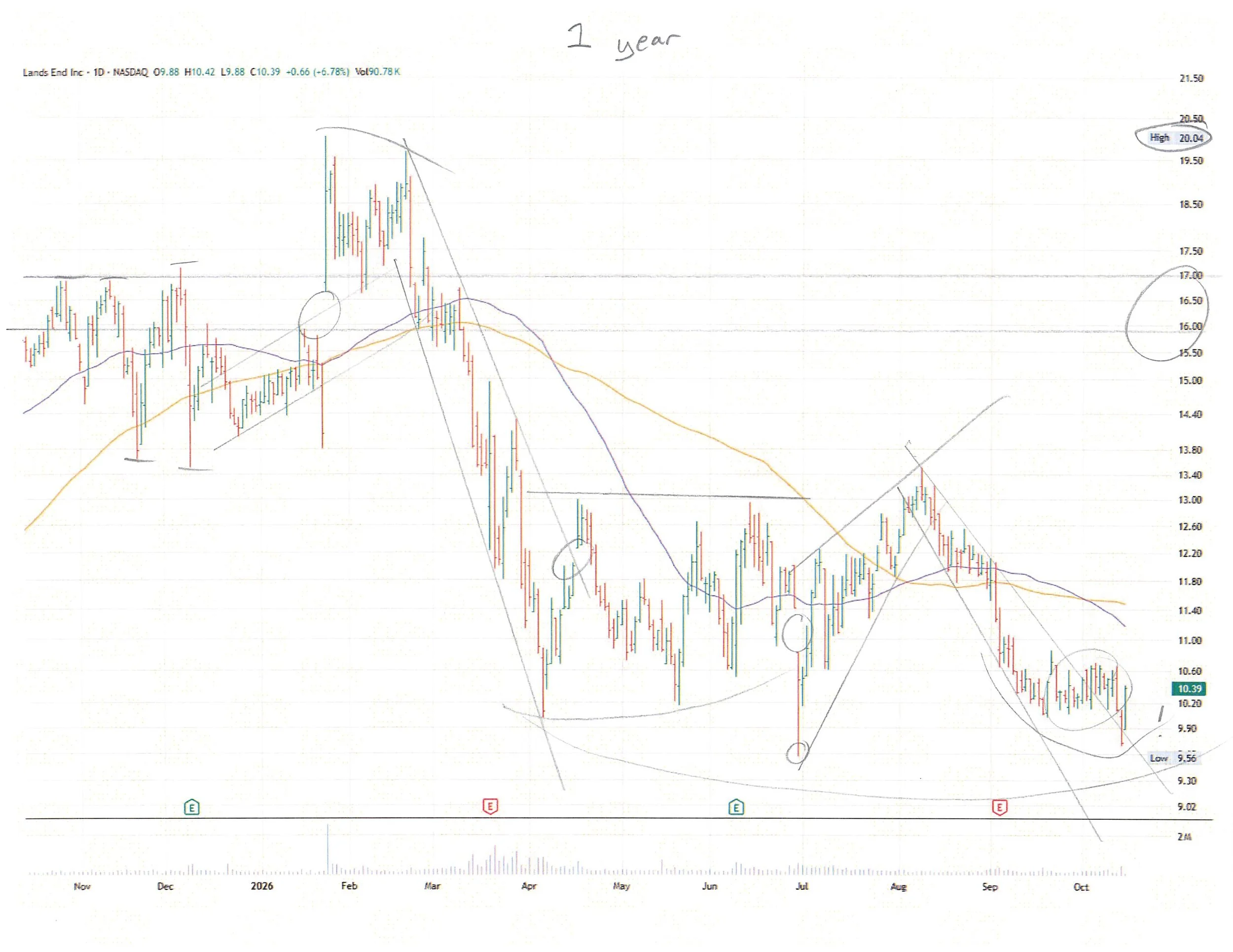
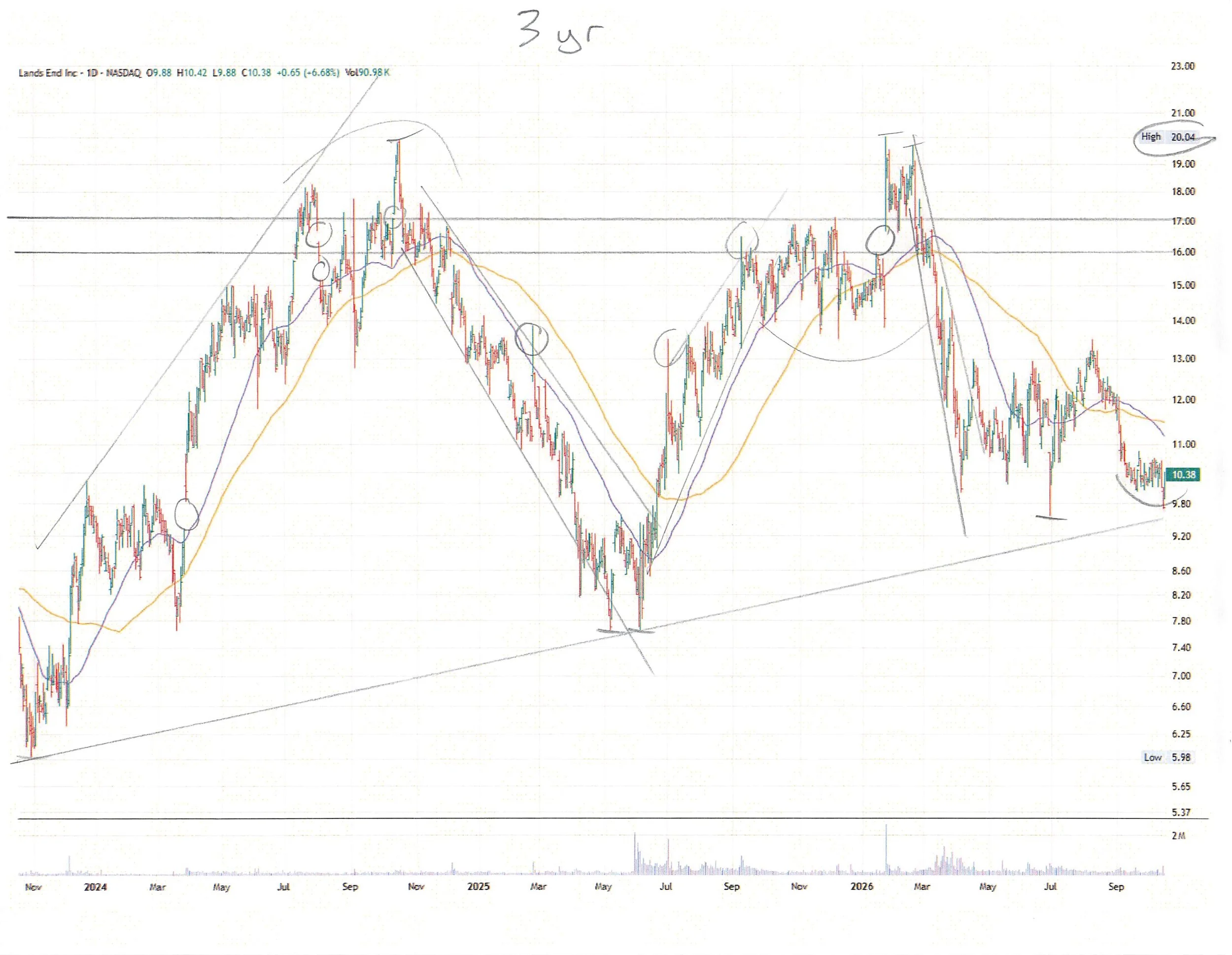
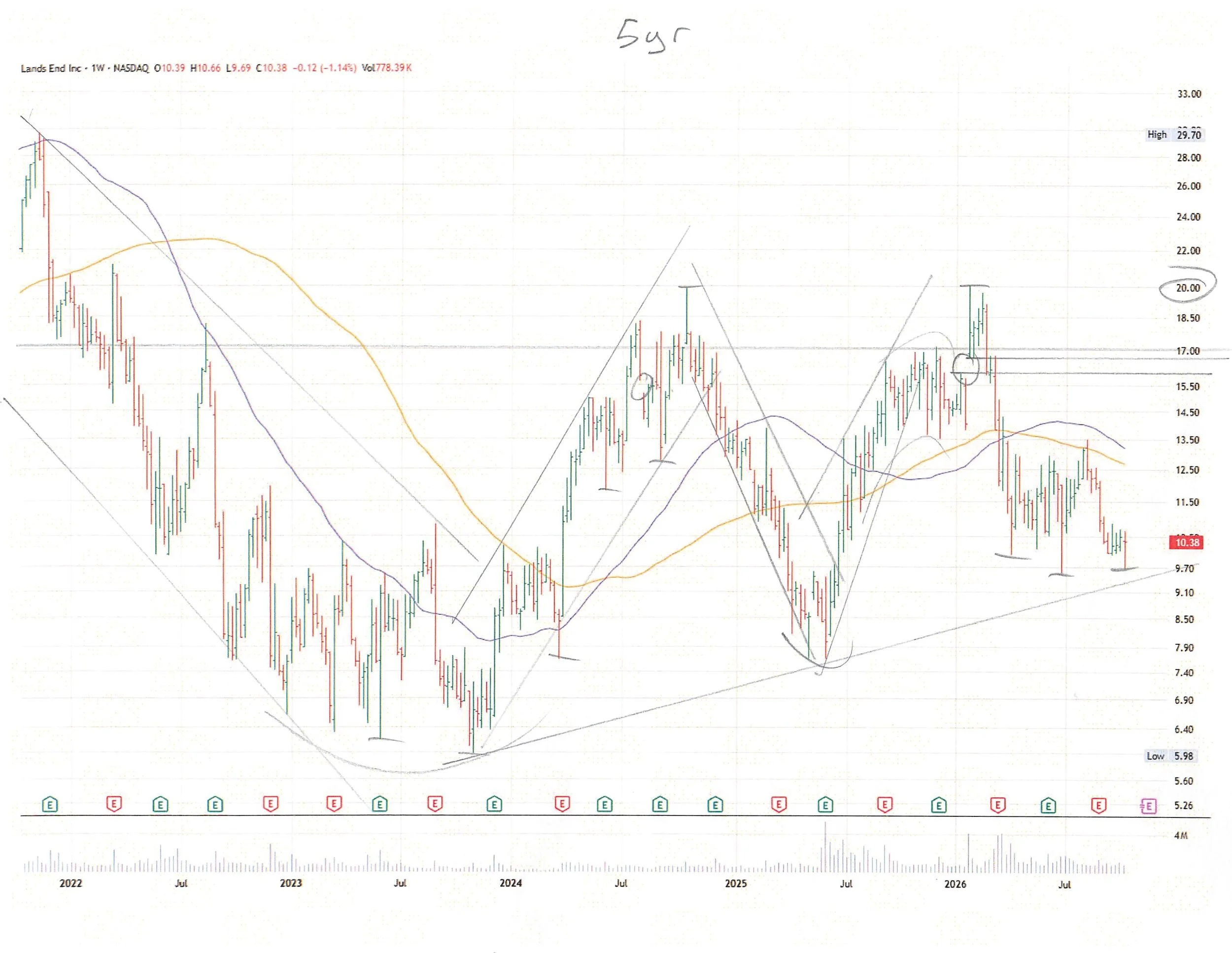
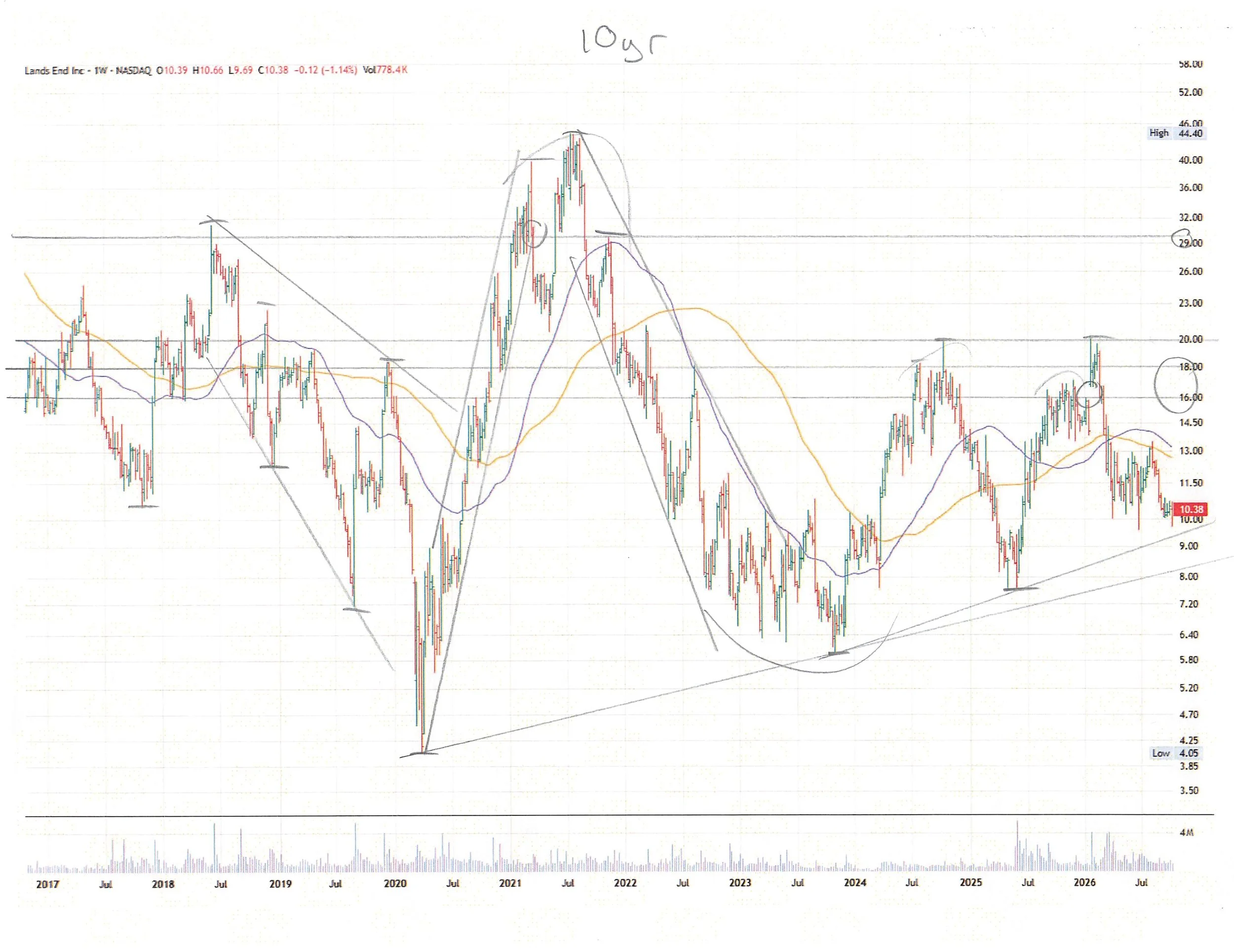
Look at the stock chart and you’ll see why casual traders are spooked—and why contrarians like us are drooling. LE’s underlying engine is running better than it has in years, but short-sighted momentum sellers pushed the stock down nearly 30% year-to-date, dragging it from $15 down to around $10.
Zoom out to the weekly chart, though, and a beautifully clear pattern of higher lows and a firm short-term bottom emerges. Sure, it’s still hanging below its key moving averages, but if it weren’t, we wouldn’t get to buy it at this absolute steal of a price. Marry these higher technical lows with booming fundamental metrics, and you’ve got a coiled spring ready for an explosive breakout.
Could macro retail headwinds cause short-term drift? Absolutely. But beneath that noise lies a battle-tested, balance-sheet-fortified champion equipped to crush the competition and deliver massive upside.

(Woodworth Contrarian 2026)
The Bottom Line: Grab Your Helmets
The WHP Global game-changer combined with Q2 2026’s monster earnings report paints a crystal-clear picture of a de-risked retail rocket ship. By exchanging an IP stake for $300 million, Lands’ End vaporized its debt nightmare and liberated massive cash flows previously swallowed by high interest. Trading far below book value with expanding gross margins, LE is an unmissable value play in apparel.
At Woodworth, we live for deep fundamental digging, bold contrarian plays, and massive long-term upside. We don't care about short-term market tantrums or timid quarterly consensus estimates. We hunt for bulletproof balance sheets and deep value opportunities that set the stage for generational outperformance. LE is a screaming BUY at current levels, with a long-term target of $16 per share.
Disclosure: This analysis is for informational purposes. Position sizing and risk management are essential. Do your own due diligence.
Please note that the Woodworth Contrarian Stock & Bond Fund, LP, of which the Millegan Brothers manage and are invested in, currently holds a position of LE as of the publication date of this article. They may or may not choose to modify their exposure to this name for any reason at any time. This is not a recommendation to buy or sell LE or any other name - investments incur significant risk, our risk tolerance may be significantly higher than the average investor, and any discussion in this article does not take into consideration your individual circumstances.
DEEP ROOTS. STUBBORN GROWTH. OREGON-BASED.
Now is a great time to diversify your portfolio with an investment into an award-winning fund. Call us or visit our website to inquire on an investment today in the Woodworth Contrarian Fund as an accredited investor.
(800) 651-1996 - info@woodworth.fund - www.Woodworth.Fund
Contrarian Value-Based Hedge Fund of the Year 2022-2026


Quinn Millegan (left) & Drew Millegan (right)
About the Managers: Brothers Drew Millegan and Quinn Millegan manage the Woodworth Contrarian Stock & Bond Fund, a hedge fund based in McMinnville, Oregon. They grew up in the finance world, and specialize in contrarian investment strategies in the US Public and Private markets.
Something missing from your portfolio may be a diversification into the Woodworth Contrarian Fund for accredited investors. Now is a great time to diversify your portfolio with an investment into a multi-award-winning fund. An exposure to a value-based contrarian strategy is a unique opportunity for your long term capital that you’re seeking aggressive returns for. With ten years of the Woodworth Fund under management, the Millegan Brothers are trained stock-pickers and experienced venture capital investors with a proven track record. Give us a call today to discuss a liquid investment with independent administration and independently audited monthly statements and a personal relationship.
